 Request a study
On the one hand, of course, the field is young. Formally, neuromarketing emerged in 2002–2004: McClure’s study on the perception of Coke and Pepsi taste in different areas of the brain caused quite a stir, along with the first mention of the term by Professor Ale Smidts of Rotterdam University.
On the other hand, the idea itself isn’t really all that new. In the writings attributed to Avicenna (which is much earlier than 2002) there is a description of a neuromarketing-like technique he used to determine the identity of a person who was refusing to speak. The American researcher of Ukrainian origin Louis Cheskin used the neuromarketing tools available to him in the mid-20th century, leaving a notable mark on marketing history as a result — the McDonald’s arches, the Marlboro Man, gift wrapping, and many other findings that have become classics today were uncovered by his team through neuromarketing insights.
So What Exactly Is Neuromarketing?
It’s the application of insights and research methods from brain science for commercial purposes. Modern people know that our perception differs from what we’re able to consciously grasp. Three Nobel Prizes in economics establishing that people are irrational, but predictably irrational, should have taken this idea beyond the circle of psychology specialists. But even now, we make 95% of our decisions unconsciously, yet we spend 95% of our effort trying to figure out the other 5%.
Neuromarketing research is exactly that key which unlocks the door to the remaining 95%. It’s good that more and more companies in Ukraine are unlocking this door for themselves, and are then drawn further in by the new possibilities and insights they gain.
 |
Would you like to find out exactly how neuromarketing can help your business?
We are the first agency in Ukraine to specialise in neuromarketing research. Drop us a line or give us a call, and we’ll be happy to advise you in detail! Kateryna Ilchenko, |
Types of Neuromarketing
Neuromarketing is divided into theoretical and instrumental. From the theoretical side, one can draw extremely useful knowledge about the laws of perception, about how attention works and by what principles; about how motivation forms; about which factors determine the success of communication; and about whether the marketing Schrödinger’s cat — loyalty — really exists, and what exactly it consists of. After all, if marketing is a battle for the consumer’s head, then studying that very head is one of the most important tasks there is.
Instrumental neuromarketing consists of studies carried out using special technologies. At the Neuro-Knowledge agency, we use EEG, an eye tracker, emotion recognition, an implicit test, and specialized questionnaires.
Studying Ad Perception
The most widespread tool in neuromarketing is the eye tracker. On the one hand, it’s fairly simple to use; on the other, it’s very informative, since vision is the primary sensory channel for humans. As a basic tool, the eye tracker serves for analyzing packaging, websites, mobile apps, and printed materials. The insights obtained using an eye tracker are extremely visual and convincing.
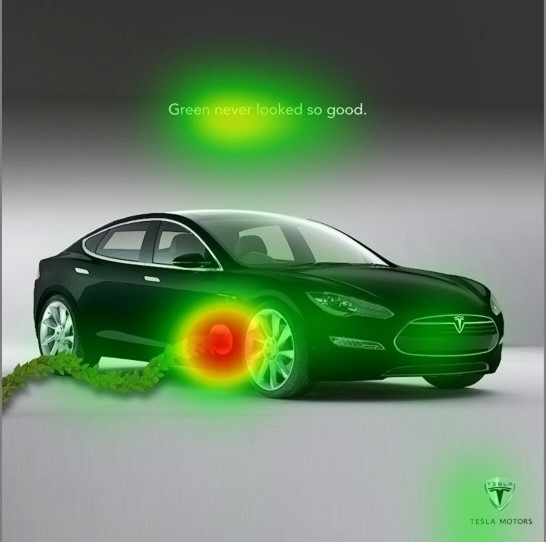
Even a beginner neuromarketer will tell you about the “dead corner”: the bottom right corner of a layout, which is usually exactly where the advertiser’s logo ends up.
A Danish agency analyzed 100 randomly selected advertising layouts and calculated that in 46% of cases, the advertiser’s logo was placed in the “dead corner.” And that includes advertising for such brands as Adidas, Tesla, Philips, and other giants.
See for yourself: the red field is the zone of greatest attention, green is what we see with peripheral vision; where there are no color gradients, the eye simply never went.

In our own studies, the same situation occurred with the Helen Marlen billboard layout:

Neuromarketing and Dynamic Content
When it comes to studying dynamic material — video — EEG data is the most informative of all: we can track, second by second, changes in engagement, attention, and motivation; we can see how changes in shots, voiceover, and story affect perception. Besides advertising materials, at Neuro-Knowledge we also work extensively with television content, helping Ukrainian TV production catch up with Hollywood.
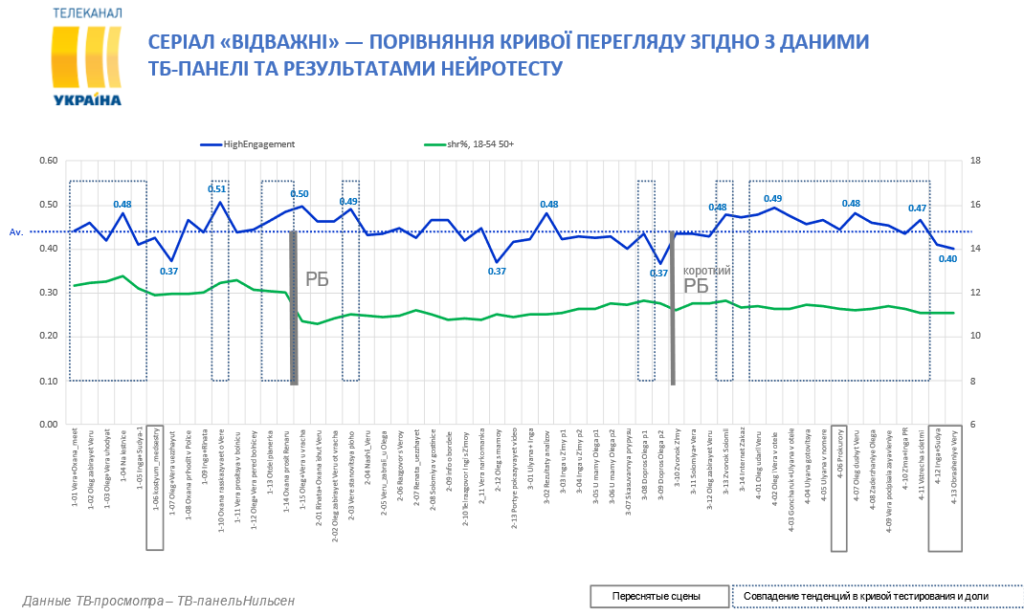
At the REMARK-2020 conference, we gave a presentation on our experience with neuromarketing research for the TRK Ukraina television channel. Tetiana Nikitina, director of the analytics department at TRK Ukraina, spoke about comparing the engagement curves of respondents obtained during the study with the actual TV-viewing curve for an episode of the series “Vidvazhni” (“The Brave Ones”). The correlation between the datasets is high, considering that the episode airs on TV with commercial breaks, while in the study it was shown without them, and some scenes were reshot after the study, which improved how they were received.
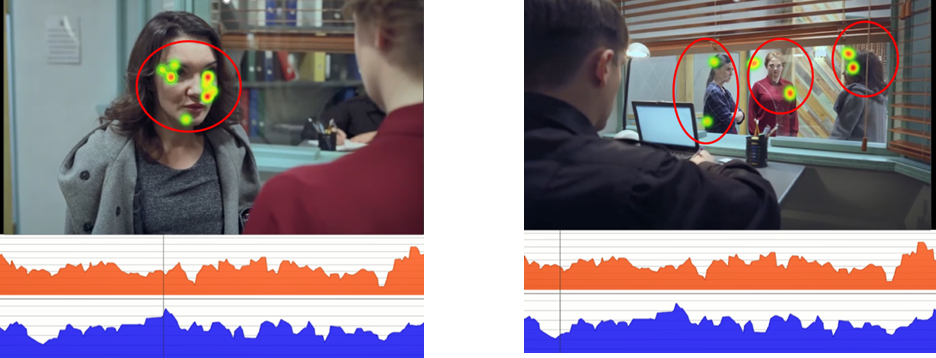
What’s most valuable for a production team is that we can see the factors that influence the metrics. Perception effectiveness is influenced not only by the story and the actors’ performances, but also by shot composition.
For instance, using sharp focus within a shot and close-ups increases viewer engagement, as can be seen from the screenshots below.
What matters here is that neuromarketing research makes it possible to study material at an earlier stage with a high degree of correspondence to how the finished material will be perceived.
With some of our clients, we have a track record of testing at the pre-production stage as well as finished commercials, and the data matches by no less than 70%, even when based on storyboards. For instance, we’ve been working with Moneyveo since 2018 and have tested several advertising campaigns for them. Right after testing the storyboards, we’re able to tell the client whether the planned campaign will outperform the previous one, what exactly is driving its success, and what would be better to adjust.
Recently, the Banda agency published a case study about a campaign for the “Molokiya” brand, which they tested together with our agency. After the commercial aired, we ran a test of the finished material and confirmed that the above-average breakthrough-through-clutter potential we had identified had held up, that the key shots retained their dynamism, and that the changes made after the animatic test allowed the commercial’s performance to improve, including its motivation score.
Why Is Neuromarketing So Effective?
Neuromarketing research makes it possible not only to break your material and your competitors’ material down into useful and harmful molecules, but also to work systematically. For instance, Mars, one of the pioneers of neuromarketing research, conducted a systematic study to understand what makes digital advertising successful. It’s no secret that, despite the growing popularity of digital media, attention paid to advertising messages there is significantly lower than on TV, in print, or on billboards. How can effectiveness be achieved with short formats? Thanks to the detail and precision of neuro-measurements, it’s entirely possible to build such a playbook for oneself.
When we talk about the precision of neuro-test data, we rely on confirmed findings. Several large-scale studies exist, including Nielsen, 2016, which tested, on a large sample, the accuracy with which different marketing research methods predict actual purchasing behavior.
The published result shows the highest accuracy for combined neuromarketing research — 84%, compared to 24% accuracy for surveys.
There are also interesting academic studies showing that the best predictor of behavior is neither expert opinion nor the respondent’s stated opinion, but precisely the interpretation of brain activity data. Worth mentioning here is the study by Alexander Genevsky, Carolyn Yoon, and Brian Knutson (2017), “When Brain Beats Behavior,” which examined the predictions and behavior of investors reviewing Kickstarter pledges. Neither the investor’s own opinion, nor their guess about which pledge would become popular, nor the bet they actually placed matched the real outcome of fundraising for those pledges — unlike the data obtained through fMRI research.
A study most closely aligned with the tasks of the advertising and marketing market, conducted based on an analysis of three variants of anti-smoking advertising, showed that neither expert assessments nor respondents’ opinions about effectiveness matched the campaign’s actual effectiveness, which was measured by the number of calls to a hotline.
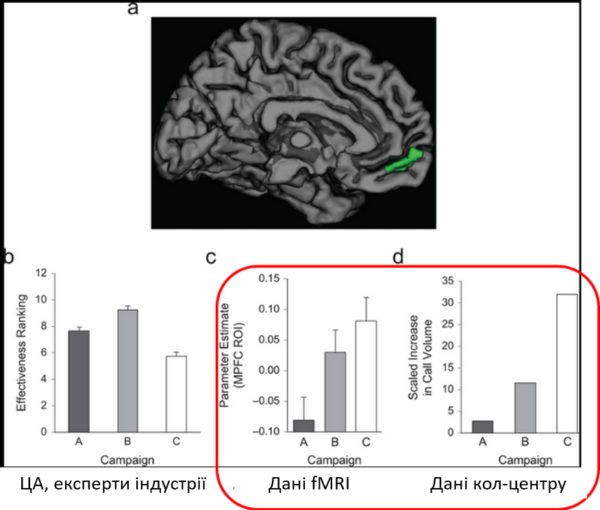
So if you want high predictive accuracy — listen to what consumers actually feel when they first encounter your materials, rather than to how they reflect on it afterward.
As for expert bias, there’s plenty of research on that too, and our agency even conducted one such study in 2019. We looked at how a marketer, a designer, and a consumer each look at an outdoor advertising billboard. The difference in time spent in visual contact with the billboard was twofold.
A consumer looks at a billboard for 1.4 seconds on average, a designer for 2.8 seconds, and a marketer for 2.4 seconds. You can compare for yourself what each of them sees while looking at the billboard.

So be careful with expert assessments — a consumer’s brain processes information differently, and this needs to be kept in mind.
And we invite everyone on an exciting journey through the brain of your client, consumer, viewer!
 Contact Us