
 Request a study
So, What Exactly Is Neuromarketing?
Neuromarketing is, first and foremost, a complex field of knowledge that studies human reactions to advertising. Its main task is to identify the patterns by which consumers respond to different types of advertising stimuli. In other words, neuromarketing is the practical application of neuropsychology in the field of marketing.
And although similar techniques, consciously or unconsciously, have been used by businesses for quite a long time, the history of neuromarketing itself only begins in the 2000s, since the term was introduced in 2002 by the firm BrightHouse (Atlanta, USA), which published the first article in this field and sponsored the first neuromarketing studies.
 |
Would you like to find out exactly how neuromarketing can help your business?
We are the first agency in Ukraine to specialise in neuromarketing research. Drop us a line or give us a call, and we’ll be happy to advise you in detail! Kateryna Ilchenko, |
How Does Neuromarketing Differ From Classical Marketing?
The main tools of classical marketing are surveys and observation. Focus groups are formed for this purpose, and based on their reactions, forecasts are made about a product’s success on the market, as well as the effectiveness of its advertising.

Surveys are one of the key research tools in classical marketing
A significant limitation of classical marketing is that only the moment of a choice already made is analyzed. In contrast, neuromarketing analyzes physiological indicators, which makes it possible to track a buyer’s reaction at a subconscious level – even before that choice is made. Of course, forms of advertising capable of influencing consumer choice have long existed; however, neuromarketing allows for a much deeper analysis – selecting the triggers most likely to work specifically on a given category of consumers. Because of this, it is sometimes compared to manipulating people’s minds.
Thus, neuromarketing goes beyond focus groups, providing an understanding of exactly how a consumer makes a choice, which areas of the brain are activated in the process, and how advertising changes this picture. Overall, this makes it possible to obtain information on how best to promote a particular product.
What Methods Does Neuromarketing Use?
The main set of neuromarketing methods consists of non-invasive ways of measuring respondents’ brain activity.
-
MRI (magnetic resonance imaging). This neuromarketing research method is widely used by scientists at Stanford University, Carnegie Mellon University, and the Massachusetts Institute of Technology to identify the parts of the brain that influence purchasing decisions. The essence of this method lies in assessing blood flow in the brain. The more active the blood supply recorded in a given area, the more active that area is while perceiving certain stimuli or performing a certain task. Its drawback is the inability to assess the process in dynamics.
-
Electroencephalography (EEG) / magnetoencephalography (MEG) — a method of graphically recording the brain’s electrical impulses, which also makes it possible to analyze the activity of a particular area during the process of thinking about a purchase. It was precisely the use of EEG/MEG for marketing research that gave rise to neuromarketing. Particular attention in these experiments is paid to understanding human behavior and decision-making when choosing a product. When we make a choice, various mental images or thoughts about it continuously arise and disappear in our consciousness. In addition, subconscious stimuli are also involved in this process. It is precisely these unconscious impulses that can often prompt someone to buy a product.
-
Lie detector. This device can not only determine when a person is lying, but also record their physiological indicators during the decision-making process, or emotional changes as a reaction to a particular advertisement (for example, when a person likes an ad, their pulse quickens, they sweat, and so on).
-
Eye tracking. This method provides an understanding of how a consumer looks at an advertisement, packaging, website, or mobile app – what they pay attention to, where their gaze lingers. This helps develop the most “selling” possible product design, and understand the difficulties that may arise when visually examining or using a product.
-
Facial emotion reading. First and foremost, this reads micro-expressions that the consumer isn’t even aware of. Despite the brief duration of these emotions, even a millisecond of furrowed brows can tell neuromarketers a lot about a first impression of a product.
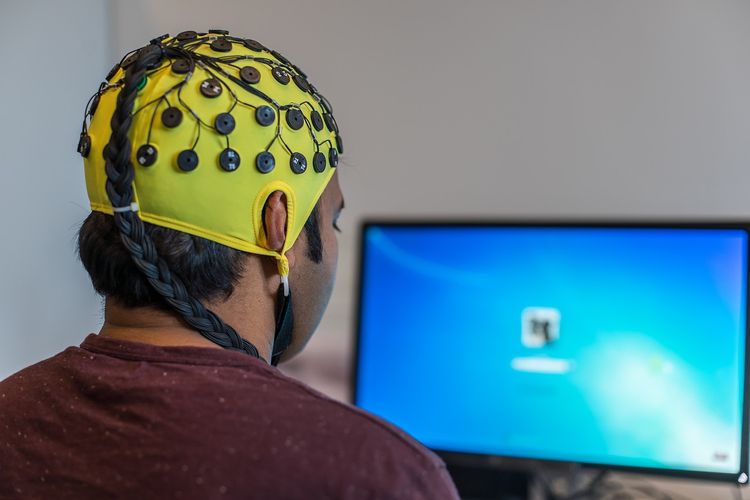
The research process using an electroencephalograph
The Goal and Objectives of Neuromarketing. What Value Does It Bring to Business?
The goal of neuromarketing is to find answers to the question of why consumers prefer one product over another, and also to develop techniques for prompting a consumer to purchase, not only on a conscious but also on an unconscious level.
Neuromarketing researchers determine how consumers react and feel when offered products and/or relevant stimuli. These observations can then be correlated with the results of classical surveys and with the emotions participants display. This information is subsequently used to determine whether a product or advertisement stimulates brain responses associated with positive emotions, and on this basis a brand’s or product’s market profile is built.
The result – more effective variations of products, packaging design, and advertising bring more sales, ensure the target audience’s satisfaction, and build their loyalty.
In addition to targeted methods involving direct participation of surveyed/tested individuals, neuromarketing is also used together with Big Data. This helps, for example, to analyze modern advertising channels (social networks, search advertising, etc.) and to identify the specifics of people’s behavior on certain web resources.
The result – optimizing the user journey on a website, directing the customer to the right product, introducing new (more effective) payment and delivery methods, and so on.

Neuromarketing is successfully used not only in offline stores, but also in online retail
That’s why practically all IT giants either turn to companies that specialize exclusively in neuromarketing research, or have their own in-house departments for this purpose. In particular, it is known that Microsoft uses EEG data to better understand user interaction with computers, while Google collaborates with neuromarketing agencies to determine audience reactions to advertisements on YouTube and identify which format viewers like best; Apple and Facebook have neuromarketers on staff.
Conducting neuromarketing research is relevant at any stage of business development – from choosing a logo and product design to creating advertising and launching active promotional campaigns.
Investments in neuromarketing pay off quite well. In the long run, they help significantly save money on advertising, since only the advertising that actually leads the consumer to purchase will be launched. Specialists estimate the ROI of neuromarketing research at 15-50%, depending on how a company works with the insights it obtains.
Thus, knowledge of the behavioral and decision-making patterns of one’s potential consumer is a powerful tool that, if used correctly, can foster growth for both large and even small businesses.
Neuromarketing in Practice
There are several cases of neuromarketing application that have become classics of this kind of research. Well-known companies such as Hyundai, PayPal, and Cheetos serve as vivid examples – all of these companies conducted powerful neuromarketing studies of potential users’ reactions to their advertising. As a result, the most effective strategies and options were selected.
The Cheetos Case
Cheetos tested an advertising commercial using both focus groups and EEG. Their ad featured a woman getting revenge on another by putting orange snacks in a dryer full of white clothes. Initially, focus group participants stated they disliked both the prank itself and the ad as a whole. But according to the EEG study results, positive brain activity was detected in those same respondents, indicating that people actually liked the commercial.
Why did participants say something different in the initial interviews? Because they didn’t want to present themselves in a negative light in front of others. In other words, the neuromarketing study showed that people don’t always say what they think, even when it comes to their reaction to a promotional video.
The Hyundai Case
Hyundai and the testing of prototypes of their cars is another well-known case of using neuromarketing in design. The company applied the EEG method; the study involved 15 men and 15 women, who were shown various concepts for a future design. Hyundai subsequently made some adjustments to the vehicles’ appearance based on the study’s results. The very fact that the study was conducted was also used for advertising purposes: “We want to know what consumers think about the car before we start manufacturing thousands of them,” Dean Macko, brand strategy manager at Hyundai Motor America, once stated.
The PayPal Case
PayPal used neuromarketing to encourage more buyers to use its online payment service. Researchers found that commercials focused on benefits such as speed and convenience triggered a significantly stronger brain response compared to promoting features like security and purchase protection. PayPal subsequently used these findings to create new advertising, which made it one of the most popular online payment services.
Drawbacks and Criticism of Neuromarketing
Like any applied tool, neuromarketing has its drawbacks.
First of all, far from every company can afford such research, since it requires complex equipment and considerable investment. However, the body of publications already available today (including in scientific journals and on the official resources of companies that have used this approach) makes it possible to extrapolate the data to other products and services.
The second important point is the complexity of interpreting the data obtained and designing the experiment. Only qualified neuroscience specialists, working in collaboration with marketers and psychologists, can carry out an effective analysis.
Third, research data is difficult to extrapolate to the market, since needs change, as does the culture of society as a whole, and as a result of some unforeseeable event, the data obtained may stop being relevant.
Many people and organizations also see potential threats in neuromarketing, in particular:
1. Privacy violations.
In a world where companies “read the minds” of consumers, the principle of privacy in a democratic society is violated. Though this point doesn’t take into account research that is conducted openly and doesn’t publish its respondents’ data.
2. Discrimination based on physiological characteristics.
Identifying products that are necessary for people with certain physiological conditions affects their final price. This point is also debatable, since this same principle is actively used even without any research at all – for example, drink prices near the beach are significantly higher than farther away from it, yet due to thirst people buy them anyway.
3. The ethical dimension.
Influencing a consumer’s subconscious “around” rational thinking and conscious choice is often considered unethical toward people. The counterargument is that advertising has always worked on the subconscious anyway, and neuromarketing has simply developed a scientific basis for such influence.
4. Companies act in their own interests and don’t take the consumer’s interests into account.
For example, when developing a brand or product, an artificial, contrived precedent is often created, and a product is then developed to fit it, which is then promoted using neuromarketing.

Personal data protection is a pressing, widely discussed issue, and it has touched neuromarketing as well
Areas Where Neuromarketing Is Used
Practically every major corporation has its own neuromarketing department focused on specific products (PepsiCo, Coca-Cola, Nestle, and so on), which selects the commercials and campaigns that are most effective. As a result, almost every one of their ads becomes widely recognized. If a piece of content “hooks” you (for example, RedBull commercials that “give you wiiings,” or a catchy jingle from a children’s product ad that’s later hard to get out of your head) – know that such videos were most likely released after thorough neuromarketing testing.
Neuromarketing is also actively used in cinema – it’s no accident that brand advertising often appears in films precisely at the moment when the viewer isn’t focused on the main plot, or a brand gets a small “role” in the film (for example, Nike sneakers in the action films “Terminator” and “Terminator Genisys”). Product placement is actively used both by companies and by film producers themselves – advertising for one film may appear inside another.
Another aspect of using neuromarketing in the film industry is getting viewers to come to a screening through a trailer, as well as making a film as successful as possible by removing triggers that cause dissatisfaction.

The task of neuromarketers in cinema is to attract more viewers to a screening and make sure they leave satisfied with the film
Thus, neuromarketing is now practically everywhere – it’s already known which packaging designs are most pleasant for consumers, and which associations/scents/emotions “sell” best. This knowledge is actively used by brands that can afford such research themselves, or that make use of results obtained by others.
Interested in neuromarketing research? Want to use it to grow your business? Then click the button below — we at Neuro-Knowledge are always ready to help!
 Contact Us